Retail tech adoption isn’t just about embracing new systems; it’s about giving your team the confidence and skills to use them effectively. According to McKinsey & Company, a strong tech foundation can triple your digital offerings’ time-to-market, double internal skill levels, and cut run costs by up to 20%, enabling reinvestment in innovation. That payoff begins with intentional, inclusive, and continuous training.
Key takeaways:
- Investment in people drives technology value; better training accelerates adoption, boosts performance, and maximises ROI.
- Retail leaders deliver higher returns than those who lag behind, with digital fluency across the workforce being the big differentiator.
- Embedding training in your tech strategy creates momentum and sustainability.
Tech & Retail Trends for 2025 and What They Mean for Training
Technology is becoming central to customer experience, shaping how teams work and how customers shop. Retailers that combine cutting-edge tools with well-prepared, confident teams will be best positioned to differentiate, delight, and grow. According to the National Retail Federation, three key trends will dominate 2025:
- AI Agents Take Centre Stage
Strategic takeaway: As AI agents automate replenishment, purchasing, and customer support, staff roles will evolve. Training must shift from transaction execution to exception handling and customer engagement.
Employees need to understand how to work collaboratively with AI tools, interpret insights, and step in when the system flags issues.
- Generative AI Powers Personalisation & Content
Strategic takeaway: Generative AI will make product recommendations, customer communications, and merchandising decisions more dynamic.
To capture value, employees need AI literacy. They must know how to interpret AI outputs, explain them to customers, and provide the “human touch” where algorithms fall short. Training should focus on building trust with customers, especially around data privacy concerns.
- Live Shopping & Streaming Gain Traction
Strategic takeaway: Livestream shopping is creating immersive, real-time experiences that blend entertainment with commerce.
Retailers must equip teams with both technical fluency (operating platforms, engaging online audiences) and storytelling skills (presenting products authentically on camera). Training should incorporate simulations and role-play exercises to build confidence in these new customer-facing formats.
The Challenge of Tech Adoption in Retail
Adopting new retail tools, from omnichannel POS systems to AI-led inventory platforms and warehouse apps, demands rapid organisational change. Organisations can run into problems when implementing new technology, including resistance, a drop in productivity, and even a refusal to use the new tech at all.
There is a price to pay for not training for technology adoption in eCommerce. According to McKinsey, retail margins have declined by 2–6 percentage points annually over the past few years, mainly due to rising complexity and increasing operational pressure. In this environment, upskilling employees is often deprioritised, leading to:
- Change fatigue: Teams are overwhelmed by constant updates and burdensome workloads.
- Confidence gaps: Without support, employees may resist tech for fear of making mistakes.
- Inadequate training: Overly generic materials don’t map to real-world customer interactions, decreasing retention and trust.
The results? Underwhelming adoption, frustrated staff, missed performance outcomes, inefficiencies in operations, and underutilised technology investments.
Why Traditional Rollouts Fall Short
Many training efforts still lean on old-school methods such as single kickoff sessions and generic slide decks with little to no follow-up. These fall short because:
- One-off delivery lacks reinforcement, skills fade, and no safety net is available when issues arise on the floor.
- Generic content lacks context, missing the nuances of peak hours, returns, or customer escalations.
- No support structure means errors persist and confidence erodes.
- Undefined alignment with business goals makes it harder for teams to grasp the “why” behind new tech adoption.
- Lack of personalised learning paths leads to learner drop-off.
Point-by-point transformation efforts rarely succeed. Retail tech adoption demands coordinated, radical shifts across tech architecture and operating models.
How Targeted Training Accelerates Adoption
According to McKinsey’s article “We’re All Techies Now”, when digital leaders embrace digital fluency across staff, their companies consistently outperform laggards by 2–6 times in total shareholder returns. Additionally, when training is woven into daily routines, adoption accelerates organically.
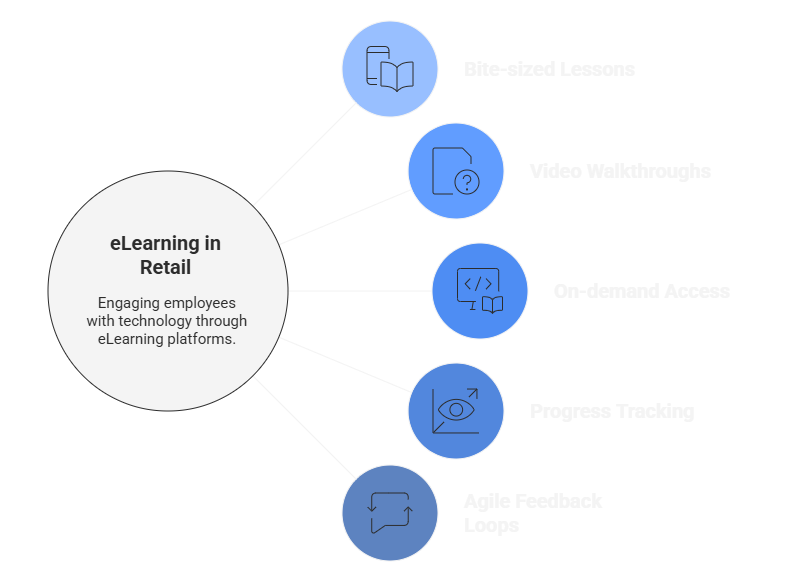
Savvy retailers are increasingly turning to eLearning to engage employees and encourage them to embrace technologies. Unlike static sessions, eLearning platforms offer:
- Bite-sized lessons: Short, practical modules that staff can complete during downtime or before shifts.
- Video walkthroughs: Step-by-step guidance makes complex features more intuitive.
- On-demand access: Staff can revisit materials anytime, which is vital for reducing errors and boosting confidence.
- Progress tracking: Managers can identify who needs extra support and step in before problems escalate.
- Agile feedback loops: Content stays relevant as tools evolve.
Building a Culture That Embraces New Tools
Even the best retail technology training programs won’t stick if employees feel change is being “done to them” rather than embraced as part of the company’s culture. Our years of working with various clients have shown that training alone doesn’t drive change, but creating a love-to-learn culture does.
If you’re struggling to embed new tech successfully, consider:
- Leadership buy-in: Tech-enabled organisations succeed when leaders champion change and connect it to business strategy.
- Peer champions: Empower “super users” or local champions to create trusted points of contact who act as on-the-ground mentors.
- Feedback loops: Integrate short feedback cycles via digital suggestion boards or regular check-ins to iterate on training or address concerns promptly. Encouraging staff to share experiences, challenges, and ideas during the adoption process builds ownership.
- Celebrate early adopters: Recognising wins such as faster checkouts or fewer stock errors (through badges, points, or leaderboards built into your LMS) builds momentum and creates psychological safety for trial and error.
Doing this aligns with a “tech-forward” mindset, where technology isn’t siloed but drives business change, reinforced by culture and organisation at all levels.
Real-World Example: Walmart’s Culture-First Rollout
When US retail giant Walmart introduced handheld devices and apps for inventory and customer service, it didn’t rely solely on classroom training. Instead, it launched “Pathways,” a gamified, role-specific training program that gave associates a safe space to practice.
Managers used the same devices on the shop floor, signalling that adoption was integral to daily operations. By making tech part of the culture, Walmart built workforce confidence and smoothed future rollouts.
Features of Effective Tech Adoption Training
The aim of retail tech adoption is to create an experience so seamless and valuable that adopting new technology becomes a natural part of the work routine, not an additional burden on already busy retail teams.
Strong training programs share these must-have characteristics:
Interactive Simulations
Scenario-based learning modules allow employees to practice safely before facing real customer situations and help learners overcome tech anxiety in the workplace. Here’s how that could work:
Simulation: “First Day with the New POS System”
Objective: Help retail staff gain confidence in using a new POS system, reduce their fear of mistakes, and build familiarity with real workflows.
Scenario: Learners are placed in a virtual store environment where they must complete a series of customer transactions using the POS system. The simulation mimics a realistic workday with escalating challenges:
- Simple tasks: Process a standard purchase and apply a discount.
- Moderate tasks: Handle a product return, resolve a pricing error, and upsell an item.
- Complex tasks: Process a split payment with a loyalty discount and troubleshoot a declined card.
Interactive Features:
- Step-by-step guidance: Tooltips or hints appear when learners hesitate.
- Safe environment: Mistakes don’t affect real data, allowing learners to experiment freely.
- Branching outcomes: Each decision leads to different customer reactions, showing real consequences in a safe setting.
- Instant feedback: Pop-ups explain correct vs. incorrect actions, reinforcing learning immediately.
Additional Support:
- Replay option: Learners can redo transactions until they feel confident.
- Leaderboard or badges: Celebrate successful completion to boost motivation and reduce fear.
Result: Staff become familiar with system features, gain confidence in making decisions under pressure, and reduce the anxiety that often accompanies new technology rollouts.
Multilingual Content
Multi-language support and cultural adaptations make training inclusive for diverse teams. One way to achieve this is to consider audio narration for people with different literacy levels.
Microlearning & Bite-Sized Content
Don’t overwhelm employees with large chunks of learning material. Microlearning modules help them adapt more easily to new tech through:
- Just-in-time learning.
- 3–5 minute modules that fit into break periods.
- Quick reference cards accessible during customer interactions.
- Progressive disclosure with basic info first and details on demand.
Personalised Comfort-Level Onboarding
Scenario: New software is being introduced across the company, and everyone needs to be onboarded. Some employees are tech-savvy, while others have minimal experience.
AI Adaptive Learning Feature: The LMS assesses each learner’s baseline knowledge through a quick quiz or interactive simulation. It then automatically creates a learning path. Beginners receive extra guidance, simplified modules, and step-by-step walkthroughs, while advanced users skip to higher-level features.
Impact: Employees progress at their own pace, reducing anxiety and preventing frustration from feeling left behind.
Dynamic Support and Reinforcement
Imagine you’re rolling out a new inventory management platform, and some staff consistently forget certain steps or shortcuts.
Here, the LMS can monitor performance data and identify recurring errors. It will then dynamically generate mini refresher lessons or cheat-sheet modules tailored to the learner’s weak points.
Gamified, Personalised Milestones
During busy hours, employees may be reluctant to try new POS features. In this case, the LMS can create a personalised gamified path with achievable milestones.
For example, completing a transaction without help unlocks a badge, while artificial intelligence (AI) adjusts the next challenge based on skill level. These small, personalised wins build confidence, reduce fear, and encourage repeated engagement with the system.
For more insights, read our Guide to Gamified Training for Retail Teams.
Mobile-First Design and Access
This is essential for front-line workers using devices on the floor. Similarly, warehouse and field teams can download training modules when they have poor connectivity, with progress automatically syncing when they are reconnected.
Embedded Feedback
Quizzes or quick surveys provide agile, feedback-driven models, ensuring that nobody falls behind. To help maintain momentum, consider achievement celebrations and rewards via badges or leadership boards.
Case in Point: Successful Rollouts with Smarter Training
Wellness Warehouse, South Africa’s leading health and wellness retailer, adopted the aNewSpring LXP (Learning Experience Platform) to train employees on their products. While it was initially successful, completion rates started declining.
The small L&D department needed branch managers’ support to encourage user engagement. However, this required the L&D team to manually input and format data from the system for 44 custom reports (one per branch) each month.
Seeking efficiency, they collaborated with New Leaf Technologies to create automated, real-time reports with the Training Intelligence System (TIS). The system provides automated, real-time, visual reports linked to learner performance. As a result:
- Completion rates jumped from 25% to 99.8%.
- Course duration dropped from 180 days to 9 days.
- L&D saved around 40 hours per report.
To see how we’ve helped clients successfully adopt technology and improve their training, read our case studies.
Get Your Teams Ready for What’s Next
Retail technology will only continue to evolve. From AI-powered analytics to omnichannel customer engagement tools, the retailers that thrive will be those who invest not just in the platforms, but in the people using them.
At New Leaf Technologies, we offer the contextual delivery platform Ziplyne, which removes the “software paralysis” that users typically face when working with new or updated software or workplace apps. It empowers teams to navigate and master new technologies effortlessly, with an intuitive digital adoption platform tailored to your context and any software application.
If you’re ready to give your staff the tools they need to succeed, contact New Leaf Technologies for structured, scalable eCommerce technology training solutions that make retail tech adoption a breeze.
FAQ
How can an LMS help reduce fear of new technology among retail employees?
A modern LMS creates personalised, adaptive learning paths and interactive simulations that let employees practice in a safe environment. This builds confidence, reduces anxiety, and accelerates retail tech adoption. Staff can learn at their own pace, ensuring that nobody feels left behind.
What makes New Leaf’s approach to training different from traditional rollouts?
New Leaf Technologies combines AI-driven adaptive learning, gamification, and real-time reporting to make training engaging and measurable. Unlike one-off sessions, our focus is on continuously reinforcing skills and providing managers with actionable insights. This ensures that retail tech adoption translates into improved employee performance and business outcomes.
Can training effectiveness be measured with New Leaf’s solutions?
Yes, New Leaf Technologies’ Training Intelligence System tracks learner progress, completion rates, and performance outcomes in real time. Automated, visual reports allow managers to identify gaps and target interventions quickly. This turns learning data into actionable insights that drive measurable business results.