

High volumes of returns and customer complaints can give any retail brand a bad name. How can today’s retailers look at reducing returns and complaints in eCommerce? The solution is to upskill and train their sales workforce to become experts in their brand and customer service.
Key takeaways:
- Online sales surpass on-street stores in complaints and product returns.
- The evolution of sales teams: part customer service, part marketing, part product expertise.
- How expert product knowledge across departments reduces returns and complaints.
- Inspiring ways an LMS can bring product training to life.
- How upskilling helps employees adapt to high transaction volumes and rapid product information changes.
Why Returns and Complaints Are a Growing Challenge for eCommerce
As consumers increasingly embrace digital shopping, returns have become a common part of the eCommerce landscape. Statista shows that, in Europe, about 7% of eCommerce revenue was returned in 2024, with more than half of shoppers in some countries sending back online purchases.
The pattern is similar in the United States, where the cost of retail returns reached $890 billion in 2024. Out of nearly $1.5 trillion in online sales, about 24.5% ended up as returns. Fashion saw the highest level of returns in both the US and UK, with clothing, footwear, and accessories topping return lists across major markets.
Things get worse when looking at customer service complaints. A report published in The Guardian shows more than 75% of Britons are frustrated with poor customer service, and that chatbot “helpers” aren’t helping. There is hope, though. Salesforce Research shows that if the company’s customer service is excellent, 78% of consumers will do business with them again after a mistake.
It goes without saying that reducing returns and complaints in eCommerce is essential for your brand reputation and customer loyalty.
According to Omniaretail, the top causes for e-commerce returns are:
- Sizing or fit issues
- Damaged or defective items
- Items that don’t meet expectations
- Change of mind or impulse purchase
- Incorrect order
- Delivery delays
- Unwanted gifts
- Misleading product information
- Incompatibility or technical issues
- Unacceptable customer service
High return rates in online retail can erode profit margins because the businesses often lose money on reverse logistics, restocking, and discounting returned items. Returns also increase operational costs by adding extra handling, inspection, repackaging, and customer service workloads.
Another point of concern is the fact that returns carry a significant environmental footprint. Returned items often travel long distances twice, generating extra transport emissions, and in some cases, they end up in landfills, contributing to waste and resource loss.
The Hidden Link Between Product Knowledge and Return Rates
According to a Consumer Returns Survey by ICSC, the average return rate for online transactions is 15.2% — three times higher than the 5% return rate for in-store purchases. The main reasons for this are that online shopping involves more uncertainty before a purchase (with no salesperson on hand to advise) and fewer consequences for returns.
As more retailers move online, often in addition to maintaining their brick-and-mortar presence, the composition of a sales team has changed significantly. Today, an eCommerce sales team is often hybrid — part customer service, part marketing, part product expertise. Instead of walking customers to the right aisle, they guide them via chat scripts, FAQs, personalised recommendations, and well-timed promotions.
Everyone on the team will touch the product in some way, and without thorough knowledge of what they’re selling, they open the business to higher rates of complaints and returns.
Let’s look at the sales team behind an eCommerce site:
1. Customer-Facing Roles
- Who they are: Product specialists, live chat and phone agents, and B2B account managers.
- What they do:
- Answer product questions via chat, phone, email, or social media.
- Recommend the best fit and upsell relevant items.
- Guide customers through purchases.
- Manage business buyer relationships, pricing negotiations, and repeat orders.
2. Behind-the-Scenes Sales Support
- Focus: Strategy, optimisation, and tools rather than direct customer contact.
- Key roles:
- Merchandising managers select products to feature, bundle, or discount.
- CRO specialists streamline checkout and increase upsells.
- Email and retention marketers recover abandoned carts and drive repeat purchases.
- Product content managers keep descriptions, images, and specs accurate to reduce returns.
3. Data & Performance Roles
- Sales analysts track performance, identify trends, and find drop-off points in the journey.
- Pricing analysts adjust prices to stay competitive and profitable.
4. Management & Coordination
- eCommerce sales managers lead teams, set targets, and align with marketing campaigns.
- Channel managers oversee marketplace sales (Amazon, eBay, Etsy) alongside the main store.
- Customer support and live chats are often the only human contact online shoppers have.
- 75% of consumers still prefer speaking to a real person (PWC).
- Skilled agents can turn issues into trust-building moments and guide buyers toward the right purchase.
How Smarter Product Training Works
Product knowledge training is your gateway to hitting business goals, boosting sales, and reducing returns in retail. The better your team knows your product, the stronger their customer relationships and support delivery will be, whether online or on the street.
Modern eLearning techniques delivered via a learning management system (LMS), such as TalentLMS, allow businesses to train employees across departments simultaneously in product knowledge and role-specific needs.
Here are the benefits of implementing a smart product training solution via an LMS:
Scalability
- Train thousands of employees simultaneously across multiple locations.
- Onboard seasonal workers quickly during peak periods.
- Standardise eCommerce training regardless of geographic distribution.
Real-Time Updates
- Push product updates instantly to all relevant departments.
- Adapt to market changes and new regulations in real time.
- Use artificial intelligence to tailor training content to job requirements and individual needs.
- Keep everyone aligned with current policies and procedures.
Performance Tracking
- Monitor completion rates and competency levels by department.
- Identify knowledge gaps and training needs proactively.
- Link training outcomes to business performance metrics.
Cross-Department Collaboration
- Create shared modules for company-wide initiatives.
- Promote understanding of how departments interconnect.
- Build empathy for other teams’ challenges and processes.
Key Features of Effective eCommerce Product Training
A modern LMS has a host of powerful features and tools used for upskilling employees in product knowledge. Here’s how it works, with examples of how in-depth knowledge can reduce returns and complaints in e-commerce:
1. Multimedia learning leverages videos, images, interactive slides, and audio to explain product features, benefits, and use cases.
For example, a cosmetics retailer might use video demonstrations to show proper application techniques, while an electronics brand could use interactive 3D models to highlight hardware components.
2. Microlearning modules break content into short, focused lessons, making it easy to learn about new products or updates in just a few minutes.
For example, whether they’re getting to grips with a new smartphone’s key specifications, or learning about seasonal fashion collections, staff can learn in digestible increments.
3. Real-time product update integration ensures that employees always have access to the latest product information, pricing changes, and stock updates.
For example, a retailer could push automatic LMS notifications when a new product version launches, so staff immediately know what’s new and can communicate it to customers.
4. Customer scenario-based learning simulations allow employees to practice applying product knowledge in realistic situations.
For example, a health supplement brand could simulate customer queries about dosage and benefits, enabling employees to respond accurately and confidently.
TIP: For more inspirational examples, take a look at our case studies.
Smarter Training = Reduced Returns in eCommerce
How is digital product training reducing returns and complaints in eCommerce? Here’s a hypothetical but realistic case study:
Case Study: Reducing Size-Related Returns at “FitStyle Apparel”
Background
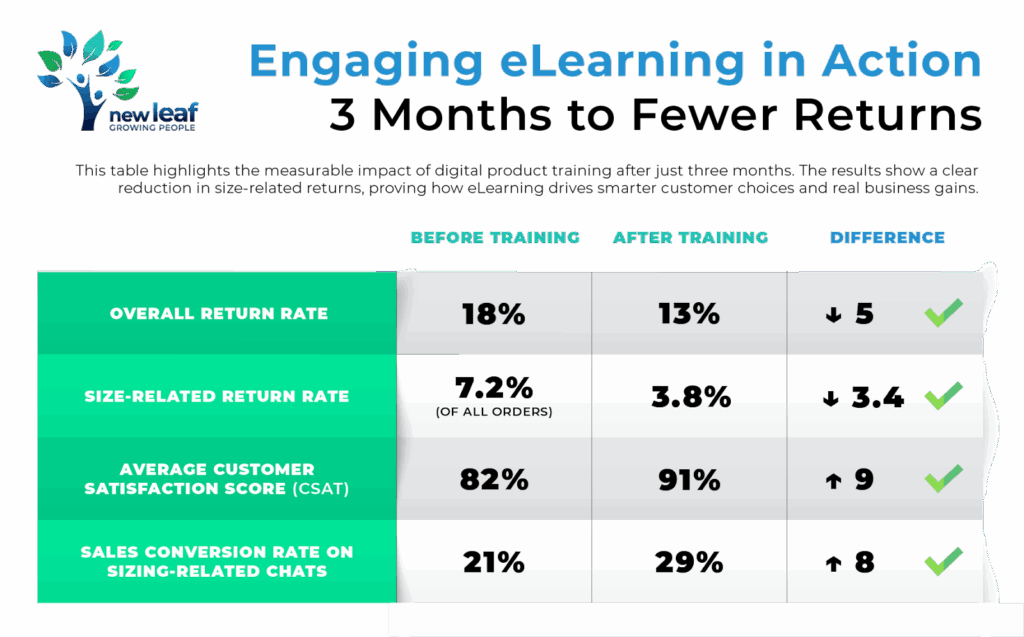
FitStyle Apparel is a mid-sized eCommerce retailer specialising in activewear. Historically, they faced a high return rate of 18%, with nearly 40% of returns due to incorrect sizing.
Sales channels included:
- Their own website.
- Live chat and phone sales support.
- A small network of physical pop-up stores.
The Problem
Sales personnel across channels were inconsistent in their sizing advice:
- Some used outdated sizing charts.
- Others guessed or gave vague fit advice (e.g., “It runs a bit small”).
- Live chat agents often defaulted to generic size recommendations without probing customer needs.
Intervention: Digital Product Training
FitStyle rolled out a two-week online product training program for all sales and customer service reps, including:
- Interactive sizing modules: Training on fabric stretch, style-specific fit differences, and updated size charts.
- Fit Finder tool walkthrough: Ensuring that every rep could guide customers through the online sizing quiz.
- Roleplay scenarios: Practising how to ask the right questions (e.g., “Do you prefer a snug or relaxed fit?”).
- Omnichannel consistency guidelines: Standardised sizing language and fit descriptors.
The engaging training modules were delivered via a mobile-friendly LMS so both in-store associates and online agents could access them on demand.
Why It Worked
- Consistent, accurate advice: Every channel now gives the same guidance.
- Confidence at point of sale: More customers trust the recommendations and feel reassured about fit.
- Proactive education: Sales reps can walk customers through tools that reduce guesswork.
- Better expectation management: More customers understand the fit before buying.
Business Impact
- Fewer returns, leading to lower reverse logistics costs.
- Improved customer satisfaction, driving repeat purchases and higher lifetime value.
Choosing an eLearning Partner Who Understands eCommerce
In today’s fast-paced retail environment, product information changes rapidly. New SKUs, seasonal lines, and feature updates appear almost weekly. An effective eLearning partner understands these dynamics and creates training content tailored to fast product cycles, ensuring that your sales teams, both online and in-store, stay up to date.
Global audiences add another layer of complexity. Employees across multiple regions need consistent, localised content that respects language, cultural preferences, and market-specific regulations. Meanwhile, high transaction volumes mean staff must absorb product knowledge quickly and apply it accurately to deliver seamless customer experiences, whether assisting a shopper in-store or guiding one online.
The right eLearning partner bridges these challenges by combining interactive, bite-sized modules with real-time updates and scenario-based learning, so your teams are always informed, confident, and ready to sell.
Ready to Reduce Returns and Improve Satisfaction?
At New Leaf Technologies, we understand that the ideal eLearning partner isn’t just a tech provider, but a strategic collaborator. Through our well-established global partner network, we offer some of the world’s best learning technology solutions, staying ahead of the trends so you don’t have to. This is your first step to reducing returns and complaints in eCommerce for your business.
Get in touch today to learn how we can support your eCommerce and retail teams and reduce returns and complaints through smarter product training.
FAQs
How does product training actually reduce product returns in eCommerce?
When sales teams and customer service agents understand product features, fit, and use cases in detail, they can guide customers toward the right purchase from the start. This reduces “trial and error” buying, manages expectations, and prevents incorrect assumptions.
What role does an LMS play in improving customer satisfaction?
An LMS helps retailers roll out training at scale. It ensures that every team member has access to accurate, up-to-date product knowledge. When employees know how to answer questions confidently, resolve issues quickly, and build trust with customers, there are fewer complaints.
Why choose New Leaf Technologies for eCommerce product training?
We understand the unique challenges of fast-moving retail and eCommerce. We offer tailored learning solutions to make training a powerful tool for protecting profit margins and enhancing customer loyalty.